Training providers and consultancies
SENCE changes the rules: the challenge is turning training into skills
Gonzalo Oviedo, founder and CEO of Closelly · 19 de octubre de 2026 · 8 min de lectura
Changes to Chile's Training and Employment Statute call for an important review by training providers and companies. Job skills, effective guidance, and assessment must be part of an experience that can be explained, delivered, and verified.

The reform of Chile's Training and Employment Statute presents a strategic decision for OTECs (registered training providers) and companies: how to sustain the value of training under new teaching and funding conditions. Reviewing the course catalog, defining support, and making learning visible will be concrete tasks during the transition.
Published on October 17, 2026, Law 21,850, titled “For National Reconstruction and Economic and Social Development,” amends Law 19,518 through Article 29. It clarifies which activities qualify as training, changes funding rules, and establishes a transition for certain registered courses. For an OTEC, this is a good time to review its full offering: the commercial promise, instructional design, and approach to supporting each participant.
At Closelly, we see a concrete opportunity: building programs in which each activity serves a workplace purpose, support is planned, and results help determine the next step.
What needs to happen during training
The amendments in Article 29 will take effect on November 1, 2026, under the law's general commencement rule, without prejudice to the transition for registered courses. The new wording excludes predominantly recreational activities without verifiable development of job skills, as well as activities that merely satisfy formal requirements without directly supporting employability, productivity, technological adaptation, or job performance.
It also excludes self-instruction without the effective involvement of an instructor, tutor, or facilitator responsible for learning. At a minimum, the text requires a mandatory opportunity for interaction, feedback, or pedagogical support, in person or remotely, and an assessment of the content learned.
This requires looking at the entire learning journey. Which skill is being developed? Who is responsible for providing support? When does that intervention happen? How is learning assessed? The answers must be built into the design and take concrete form during delivery.
The distinction matters for digital training: the text does not amount to a ban on all asynchronous experiences. Learning at different times can coexist with support and assessment. Nor does it equate gamification with excluded recreation: a game-based activity should be examined in terms of its learning purpose and the skill development it allows people to verify.
This change has precedents. SENCE had already amended its administrative framework through Exempt Resolution 632, issued on March 3, 2026, with an extract published on March 6, to stop authorizing new courses in the Distance–Self-Learning modality. The October law incorporates conditions into the statute itself and provides for adjustments to courses with current registration. These two measures should be distinguished when reviewing each program.
Put a skill at the center
Consider a hypothetical example: an OTEC prepares a program for managers who need to give feedback to their teams. The skill could be expressed observably: describe a situation using facts, listen to the other person's perspective, and agree on an improvement action.
Starting from that objective, the learning journey can combine short content, case analysis, practice, and a mandatory support session led by the person responsible for instruction. Learning capsules must be integrated into a program with the duration, modality, and conditions required by its authorization. Assessment must make the defined criteria observable, using an instrument and conditions appropriate to the course.
Coordination must make clear what each participant completes, when they receive support, and which records are retained. A progress view helps identify outstanding work; responses and results help review learning. Each record serves a different purpose.
This design makes it possible to explain to the client what the program aims to achieve and how participants will be supported. Practice results provide information about that experience; evaluating workplace performance requires additional evidence and context.

Where technology contributes
A platform can provide continuity throughout this journey. In Closelly's solutions for training providers and consultancies, content and activities are organized into learning paths, with mobile and web access. Teams can review participation, progress, and results to guide follow-up.
LENA adds opportunities for questions, role-play practice, and conversational assessments, depending on the program's configuration. It can help participants understand content, rehearse a situation, and receive feedback within the learning experience. Scenario design, criteria, and review of results still require pedagogical responsibility.
As a design proposal, human review can be organized alongside the learning journey, without requiring participants to wait for manual marking before continuing with the content. During the planned closing stage of the course, the responsible instructor could revisit the practice already completed with LENA and give each participant specific feedback: which criterion they met, what could improve, and how to apply it. This uses existing work without requiring an additional task.
That feedback must be a mandatory part of the course, be effective, leave evidence that it took place, and coexist with an appropriate assessment. Progressing through activities and formally completing requirements are different milestones. The suitability of this design must be verified against the modality, course authorization, and applicable SENCE instructions. Final feedback alone does not guarantee compliance in every program.
LENA can support learning and practice; its use alone does not establish the effective intervention required. How that review is organized and communicated must be agreed for each implementation.
AI creation tools also help prepare and update materials. Their usefulness depends on editorial and pedagogical review that checks content, activities, and assessments before they reach participants.
The aim is to connect learning, practice, support, and management. Each implementation must specify the enabled capabilities, responsible people, required evidence, and approach to resolving outstanding issues.
Operational efficiency is also part of the response
Operational efficiency matters in both planning and delivery. Coordinating participants, identifying outstanding tasks, requesting declarations, and gathering closing records takes work. Automating repetitive tasks can reduce manual follow-up and help teams focus on people who need support or present an exception.
Closelly supports sworn declaration management through agreed participant uploads or synchronization, individual links, and status tracking. Depending on the contracted configuration, LENA can support requests and WhatsApp reminders for participants whose signatures are pending. Each participant reviews, authenticates, and signs their declaration; the team can monitor the process, download reports, and consolidate declarations issued inside and outside Closelly.
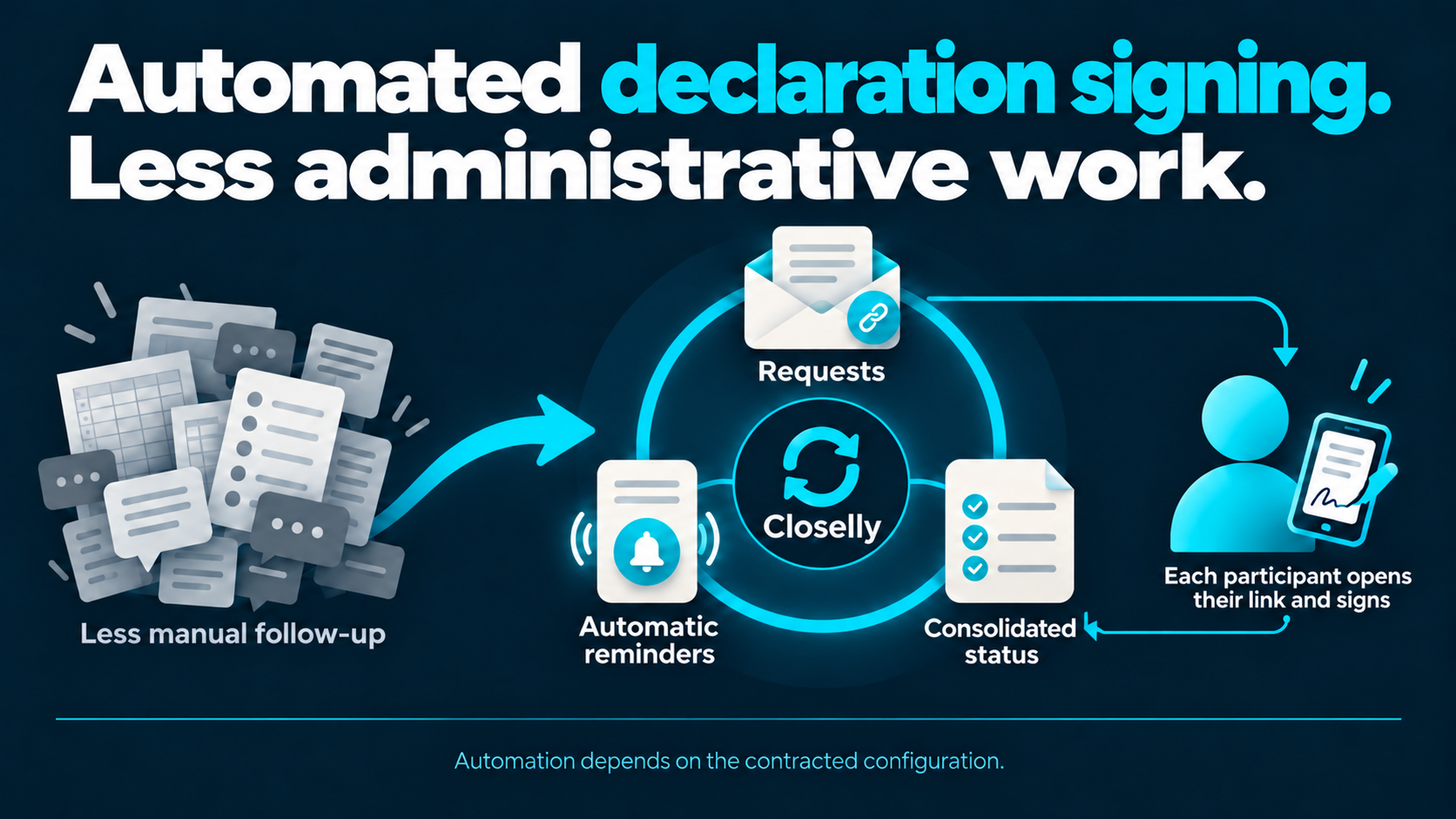
If the OTEC uses Moodle, updating a course activity or status can be assessed through an implemented and validated integration. Data, permissions, exceptions, and responsibilities must be agreed. Declaration signing and evidence of learning are managed as distinct records: automating the administrative process does not replace support or assessment, nor does it imply an official integration certified by SENCE.
Budgets also need a new conversation
The reform will reduce the general annual training tax-credit limit from 1% to 0.7% of taxable remuneration paid to staff during the year. For the bracket of monthly taxable remuneration up to 25 UTM, the maximum eligible proportion will fall from 100% to 80%. The limits remain at 50% for remuneration above 25 and up to 50 UTM, and 15% for remuneration above 50 UTM. These percentages apply to the hourly value per participant established under the law. The company must fund the difference and may not pass it on to employees.
For OTICs, the law also introduces a cap of 10% of contributions managed during the financial year for administrative expenses. This provision concerns these intermediary organizations and must be distinguished from an OTEC's operations.
When preparing a quote, review the other applicable conditions, participant segmentation, and planned contributions with the relevant OTIC or adviser. The 2026 tax transition requires particular attention to official instructions; percentages alone do not determine the coverage of a proposal.
The commercial conversation can become more precise: which need will be addressed, how the program will be delivered, what support participants will receive, and which learning outcomes will be reported. A well-designed offering makes the work behind training visible.
The transition requires organizing the work now
The general commencement date for Law 21,850 is November 1, 2026, without prejudice to its special provisions. For currently registered courses that do not meet the new conditions in Article 10, transitional Article 22 establishes a six-month adjustment period beginning with publication on October 17, 2026.
The law requires requesting an update or amendment to the registration from SENCE in the manner determined by regulation. If the request is not made within the deadline, or is rejected for noncompliance, SENCE will revoke the corresponding registration. Procedures and operational instructions must be checked against the official sources in force when action is taken.
The first step is to review the catalog: identify courses that need adjustments, specify skills and assessment, design support, and prepare the necessary changes. In parallel, review budgets and map operations: participant uploads, communications, sworn declarations, reports, and exceptions.
The opportunity is to use this review to strengthen training: design each course better, provide purposeful support, and produce useful evidence for learning and improvement. Operational efficiency helps sustain that work. That is the contribution we want to make at Closelly.
Explore Closelly's solutions for training providers and consultancies, and let's discuss your program, the support it needs, and the administrative processes worth simplifying.
Scope note. This article is informational and reflects a reading of sources available as of October 19, 2026. Applying it to a particular course or company requires reviewing its specific circumstances and the relevant regulations and operational instructions. Using a platform does not guarantee approval or regulatory compliance.