Closelly Readiness
Show who is ready to perform.
Define skills and observable criteria, assess knowledge and execution capability, identify gaps, and activate the development each person or team needs.
For launches, sales, service, leadership, compliance, safety, and critical changes.
- SkillField safety conversation
- EvidencePractice assessed against defined criteria
- Readiness levelAchieved, developing, or gap identified
Readiness Score
DemonstrationThe workplace situation is translated into observable criteria and consolidated evidence.
- Identify the deviation
- Achieved
- Stop the task and explain the risk
- Developing
- Verify the correction
- Gap
Demonstration view with fictional, anonymized data.

- Conversational assessments
- Role-plays
Completion is not the same as readiness
Participation shows activity. Readiness seeks evidence of execution.
Readiness complements training and can operate within Closelly programs or alongside other platforms, consultancies, and methodologies.
How you trained people is not the only thing that matters. You need to know whether they can perform when the moment comes.
Traditional signal
Readiness evidence
- Course completed
- Criteria demonstrated
- Knowledge grade
- Knowledge and application
- Overall average
- Results by skill and criterion
- One final result
- Gap, feedback, and next action
- The same path for everyone
- Reinforcement based on need
From expectation to evidence
Define, practice, demonstrate, and improve.
- 01
Define
Start with the knowledge your organization already has—protocols, manuals, policies, guides, playbooks, product information, or process documents—and establish skills, behaviors, criteria, expected levels, audiences, and context.
- 02
Activate experiences
Combine questions, conversational assessments, role-plays, activities, or evidence according to what needs to be observed.
- 03
Assess and consolidate
LENA and the experience configuration help analyze responses and performance against defined criteria. Results are consolidated into skills and a Readiness Score.
- 04
Act and measure again
Identify gaps, provide feedback, activate practice or learning, and compare progress.
The involvement of AI, human review, and automation depends on each project's design, risk, and configuration.
Authentic practice and assessment
Observe how a person responds, decides, and acts.
Core platform capability
Conversational assessments
Ask open-ended questions, explore responses further, and assess reasoning, understanding, or application against configured criteria.
Structure of a conversational assessment
- Open-ended question
- What would you do if you detected the deviation halfway through the shift?
- Follow-up
- What exactly would you say to stop the task?
- Criterion assessed
- Explains the risk and verifies the correction.
Provisional scene with fictional data: an authentic screenshot will be incorporated after anonymization.

Core platform capability
Role-plays
Practice realistic conversations and situations with characters, objectives, context, and observable feedback.
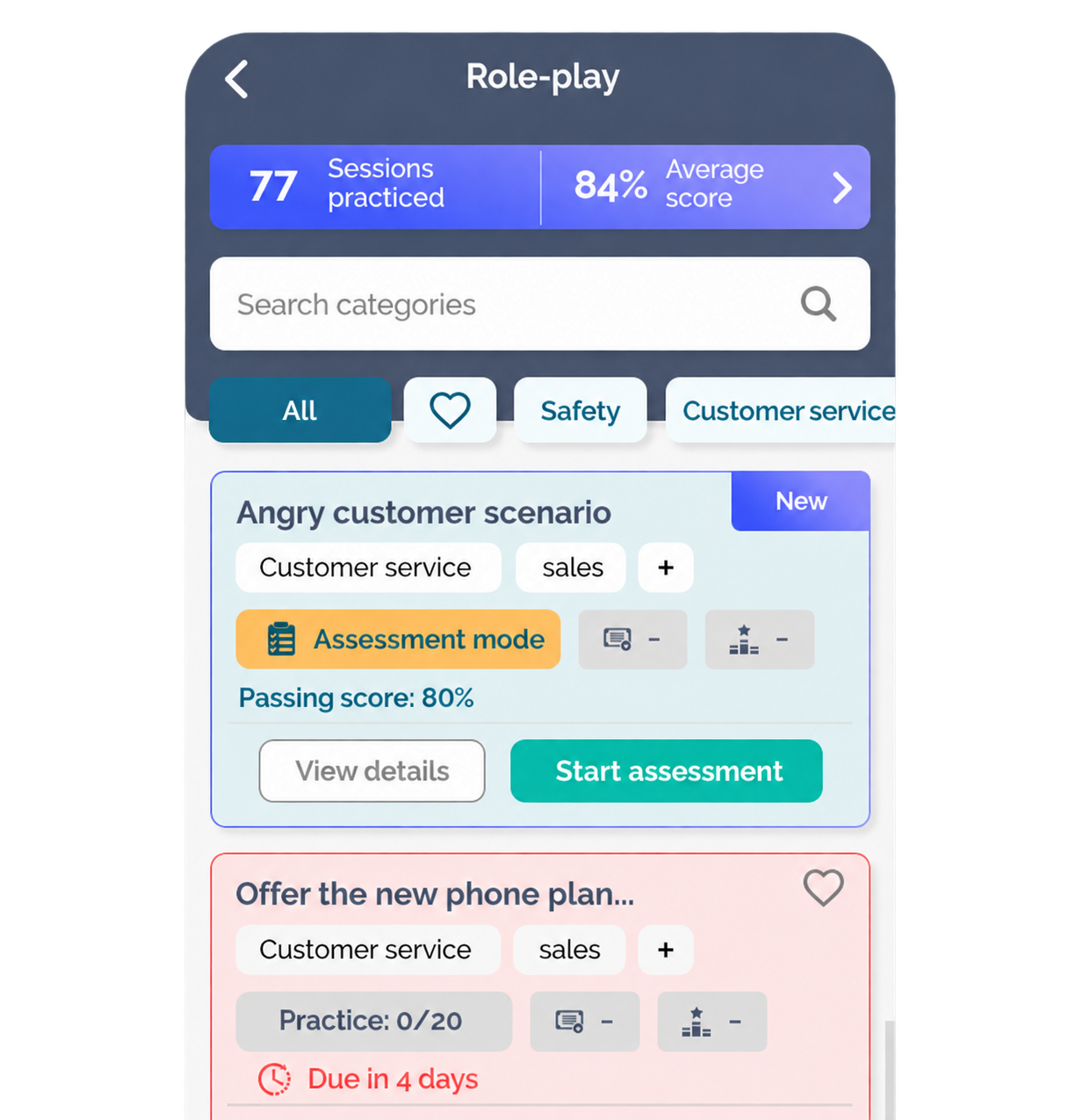
These capabilities are part of Closelly's core platform. Readiness incorporates them when they help demonstrate skills and preparedness.
An interpretable signal, not a black box
Understand the result and the evidence behind it.
The Readiness Score can consolidate results configured for an experience, while detailed views let you analyze each dimension of preparedness.
Skills, criteria, activities, levels, and weightings are configured according to the project's purpose.
- skill
- observable criterion
- activity or evidence
- expected level
- result achieved
- strengths
- gaps
- recommendations or next steps
- segment, team, or person according to permissions
Skills view (view structure)
| Skill | Expected level | Evidence | Result |
|---|---|---|---|
| Safety conversation | Applies in a real situation | Role-play | Developing |
| Protocol application | Makes the correct decision | Conversational assessment | Achieved |
| Recording and traceability | Performs without support | Practical activity | Gap |
Illustrative structure with fictional, anonymized data, labeled as a demonstration. Each project defines its own skills, criteria, and levels.
From gap to action
Each result opens a different decision.
Ready
The evidence meets the defined level. The team can move forward, receive internal certification, or maintain practice, depending on the project.
Needs reinforcement
There is a trainable gap. Content, practice, coaching, or a new assessment can be assigned.
Needs a different intervention
The cause may involve processes, tools, incentives, clarity, leadership, or other barriers that training alone cannot resolve.
Not every low result is resolved with an automatic course recommendation.
When good execution is critical
Where Readiness is used.
Featured use case
Launches
New products, services, campaigns, or commercial changes.
- Sales and service
- Conversations, diagnosis, objections, recommendations, and protocols.
- Leadership
- Feedback, difficult conversations, delegation, and decision-making.
- Compliance and safety
- Understanding, decisions, and application of procedures.
- Operations
- Standards, protocols, quality, and responses to situations.
- Transformation
- New processes, tools, behaviors, or ways of working.
- Operational onboarding
- Practice and validation of critical tasks before working independently.
Readiness does not provide automatic regulatory certification: the evidence supports the internal certification defined by the organization.
From protocol to execution
Attendance does not demonstrate a new safety protocol.
Before
The organization distributes the manual, delivers a talk, records attendance, and administers a quiz. It knows who participated, but not yet who can respond correctly in a real situation.
With Readiness
The authorized protocol becomes criteria and scenarios. People study when appropriate, complete a conversational assessment, practice decisions or conversations, receive feedback, and try again. Leaders observe evidence, gaps, and readiness levels.
From recording training to gaining operational confidence before a costly error occurs.
Implementation options
Readiness can start small and grow with the need.
Readiness validation
Define criteria, assess, and identify who is ready.
Preparation and gap closure
Assess, provide feedback, activate reinforcement or practice, and measure again.
Integrated program
Connect diagnosis, learning, practice, assessment, Readiness, and Insights.
It can be implemented as a standalone product or integrated with the Closelly platform and the organization's existing ecosystem.
Decisions for leaders and teams
Questions the evidence can answer.
According to defined permissions, training, operations, or business leaders can review:

- which people or teams reach the expected level?
- which skills have gaps?
- which criteria present the most difficulty?
- which segments need priority support?
- which intervention fits each gap?
- how does readiness change after reinforcement?
- which patterns recur across locations, departments, roles, or shifts?
Every demonstration uses anonymized data. Client dashboards and real names are not published.
Integration with the Closelly ecosystem
Readiness consolidates evidence of preparedness.
Training needs analysis
Helps identify priorities and causes.
View training needs analysisLearning
Develops knowledge and skills.
View LearningLENA
Converses, practices, assesses, and provides feedback.
View LENAReadiness
Consolidates evidence of preparedness.
Current page
Insights and MCP
Help understand results and connect them with authorized decisions.
View Insights and MCP
This is not a mandatory, rigid sequence: an organization can start with Readiness without purchasing every component.
Methodology and traceability
Designed for real readiness decisions.
We have not yet published Readiness case studies. We describe how a project is configured, documented, and safeguarded instead of simulating client results.
- Documented criteria and configuration
- Skills, behaviors, levels, and weightings are made explicit before measurement.
- Activity and result traceability
- Each result can be linked to the activity and evidence supporting it.
- Segmentation and permission-based access
- Each role sees the appropriate level of detail.
- Human review when the context requires it
- Project design determines which decisions need human validation.
- Anonymized data in demonstrations
- Example views contain no real people, teams, or organizations.
- Scope and retention defined by project
- Information handling is agreed with each organization.
Frequently asked questions
Common questions about Readiness.
- Does Readiness replace our LMS?
- No. It can complement your current platform or integrate with the Closelly ecosystem.
- Do role-plays and conversational assessments require Readiness?
- No. They are core platform capabilities; Readiness can incorporate them to measure preparedness.
- What does the Readiness Score measure?
- It consolidates the criteria, skills, activities, and weightings defined for each experience or project.
- Can it adapt to our skills framework?
- Yes. Skills, behaviors, criteria, levels, and audiences can be configured according to the purpose.
- Does Readiness only measure knowledge?
- No. It can combine knowledge, reasoning, application, practice, and other configured evidence.
- What happens when someone has a gap?
- You can provide feedback, assign reinforcement or practice, review other barriers, and measure again.
- Can we start with a pilot?
- Yes. It can focus on a critical situation, population, or skill before expanding the scope.
- Does AI make decisions automatically?
- AI can support analysis and feedback against criteria; project design defines controls, human review, and authorized decisions.
Closelly Readiness
Let's define what being ready means in your organization.
Tell us which situation, change, or capability you need to validate. We can start with one critical case and design a measurable pilot.